
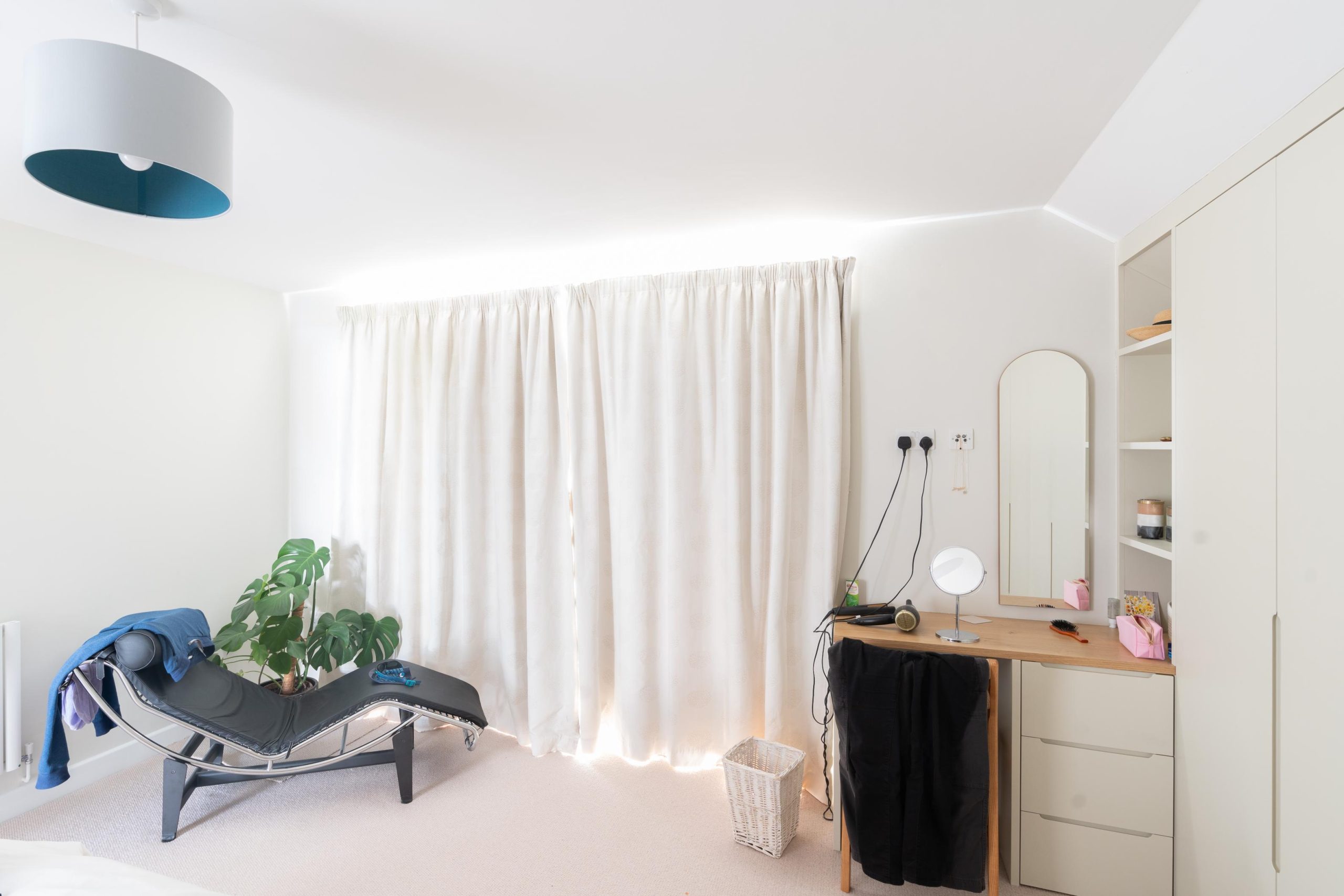
Yes, curtains can help insulate a room.
They won’t replace effective glazing or repair a draughty window, but a well-fitted pair of lined curtains adds another layer between the room and the glass. This can reduce cold spots, limit unwanted air movement and make the space feel more comfortable.
The fabric, lining, size and fit all matter. A thin curtain that barely covers the window will offer far less benefit than a made-to-measure thermal curtain fitted with generous coverage.
How do curtains provide insulation?
Windows are often one of the colder surfaces in a room during winter. Warm indoor air reaches the glass, cools and begins to circulate back into the space.
When curtains are closed, they create a pocket of air between the fabric and the window. A heavier or thermally lined curtain can slow this movement and reduce the sensation of cold coming from the glazing.
Curtains may also help limit small draughts around the edges of older windows. However, persistent draughts should still be investigated rather than simply covered.
What are thermal curtains?
Thermal curtains are made with insulation in mind.
The term may describe curtains made from a dense fabric, curtains with a specialist thermal lining or curtains that have been interlined with an additional layer between the face fabric and the standard lining.
The extra construction can help the curtain:
- Retain more warmth during colder weather
- Reduce the feeling of cold near a window
- Hang with a fuller, more substantial appearance
- Soften some of the heat entering through sunny windows
- Improve privacy and light control
Brighton Sunblinds’ made-to-measure curtains can be supplied with different lining and interlining options according to the room.
Fit is just as important as fabric
Buying the thickest curtain available won’t guarantee good insulation if it doesn’t cover the window properly.
Warm air can continue to move around curtains that are too narrow, too short or fitted a long way from the wall. For improved coverage, curtains should usually:
- Extend beyond both sides of the window
- Reach close to the floor or windowsill
- Close fully without pulling at the centre
- Hang reasonably close to the window
- Have enough fullness to avoid stretched, flat fabric
Made-to-measure curtains are useful because the width, drop and fullness are calculated for the actual window rather than based on a standard size.
Are floor-length curtains more insulating?
Floor-length curtains often provide better coverage than shorter curtains because they reduce the open space beneath the window.
However, the layout of the room needs to be considered. A long curtain shouldn’t cover a radiator while the heating is on, as this can trap warm air behind the fabric rather than allowing it to circulate into the room.
Where a radiator sits directly beneath a window, shorter curtains, blinds or a carefully planned layered treatment may be more practical.
Do curtains help during summer too?
Curtains aren’t only useful in winter.
Closing curtains before strong sunlight enters the room can help reduce heat building up indoors. This is especially relevant for windows that receive direct sun for several hours during the day.
The greatest benefit comes from acting early. Once the room and its surfaces have heated up, closing the curtains will have less effect.
During warm weather:
- Close curtains on sunny windows before the room becomes hot.
- Keep them closed while direct sunlight is hitting the glass.
- Reopen them once the sun has moved away.
- Ventilate when the outdoor air is cooler than the air inside.
For rooms where heat control is the main concern, curtains can also be combined with thermal or made-to-measure blinds.
Should curtains be open during sunny winter days?
On bright winter days, opening the curtains allows sunlight to contribute some free warmth.
Once daylight fades and the temperature drops, closing them helps retain the room’s existing heat. Building this into your daily routine costs nothing and allows the curtains to work more effectively.
Are blackout curtains the same as thermal curtains?
Not necessarily.
Blackout lining is designed primarily to prevent light passing through the fabric. Thermal lining is intended to improve insulation.
Some curtain linings offer both benefits, but the terms shouldn’t automatically be treated as interchangeable. When choosing curtains, be clear about your main priority:
- Reducing early morning light
- Improving privacy
- Retaining warmth
- Softening summer sunlight
- Creating a fuller appearance
A curtain specialist can then recommend the most appropriate fabric and lining combination.
Do blinds and curtains work well together?
Layering curtains with blinds can provide greater control throughout the year.
The blind can be adjusted during the day to manage glare and privacy, while the curtains can be closed fully in the evening. The additional layers may also improve comfort around a large or exposed window.
A simple roller blind behind a lined curtain is a versatile combination. For stronger thermal performance, cellular products such as Duette® blinds may also be considered.
Will thermal curtains reduce energy bills?
Thermal curtains can form part of a sensible approach to reducing household heat loss, but it’s best not to view them as a guaranteed bill-saving product.
Their impact depends on the window, the curtain construction, the fit, the building and how consistently they’re used.
They’re most effective when combined with measures such as:
- Repairing damaged window seals
- Addressing uncontrolled draughts
- Using heating controls properly
- Closing curtains at the right time
- Maintaining appropriate ventilation
- Improving glazing where practical
The main immediate benefit is often comfort. A room that feels less draughty or cold near the window may be more pleasant to use.
Thermal curtains in Brighton and Sussex
Brighton Sunblinds supplies made-to-measure curtains with a choice of fabrics, linings, headings and fitting systems.
Our team can help you balance insulation with practical details such as radiators, window depth, curtain length and the amount of available stacking space.
Browse our curtain collection, read more energy-saving window advice or book a free home consultation in Brighton, Hove or the wider Sussex area.